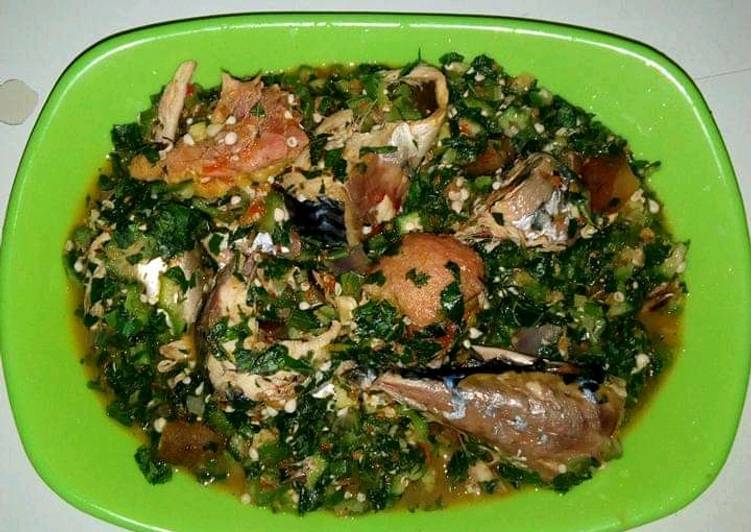
Hello everybody, hope you are having an incredible day today. Today, I’m gonna show you how to make a distinctive dish, spring onion & alaiyaho. It is one of my favorites food recipes. For mine, I’m gonna make it a bit unique. This will be really delicious.
Spring onion & Alaiyaho is one of the most well liked of current trending foods in the world. It’s easy, it’s quick, it tastes yummy. It is appreciated by millions every day. They are fine and they look fantastic. Spring onion & Alaiyaho is something that I have loved my whole life.
Spring onions, on the other hand, look similar to scallions, but you'll notice that they have small Spring onions are sweeter and mellower than regular onions, but the greens are more intense in. Scallions, green onions, spring onions.oh my?! These names are used interchangeably and often wrong. I explain it all in this video.
To begin with this recipe, we must prepare a few components. You can have spring onion & alaiyaho using 5 ingredients and 3 steps. Here is how you cook that.
The ingredients needed to make Spring onion & Alaiyaho:
- Take Nama da kifi
- Make ready Lawashi da alaiyaho da koren tattase
- Prepare Kayan miya
- Get Mai da su maggi da kayan kanshi
- Make ready Tafarnuwa da citta
If you love tasty, versatile vegetables that only need minimal space and effort, then spring onions are an excellent choice! Spring onions are useful for adding a marked onion note to dishes, particularly when used raw. Pick a normal onion early in the growing season and you'll get a spring onion. Spring onions have dark green hollow-tubed leaves and a white bulb.
Steps to make Spring onion & Alaiyaho:
- Da zaki daura naman ki a wuta kisan albasa da kayan kan shi har da tafarnuwa da citta
- In naman ya nuna ki aje a gefe sai ki gyara kifin ki nayi amfani da kifin nan da ake gasawa kwalla fishi in kin gyara ki aje shima sai ki saura mai a wuta kisa albasa da dasu tafarnuwa ki soya
- In albasan ya fara soyuwa kisa jajjagen kayan miyan ki ki soya kisa kayan kanshi da maggi sai kisa kifin ki da nama kiyi ta soyawa ki ajiye ruwan naman a gefe sai ki nemi wani tukunya kisa mai da albasa kisa alaiyaho kiyi ta toyawa in ya soyu sai zuba a kayan miyan sai kisa koren tattase da lawashi kisan ruwan naman zaki iya kara kayan kanshi in baijiba sai ki juya miyan ki bashi minti biyar yanuwa sai ci zaki iya ci da rice, macaroni, kuskus ko tuwo ma 😍
Pick a normal onion early in the growing season and you'll get a spring onion. Spring onions have dark green hollow-tubed leaves and a white bulb. They are a versatile vegetable that is popular in Asian cuisines. An excellent source of vitamin C and dietary fibre. Scallions, green onions and spring onions are commonly used in Asian, American and European Spring onions are usually planted at the end of summer so that they grow over winter, ready for.
Which means at any particular spring onion & alaiyaho time in your cooking learning cycles there’s quite probably some one somewhere that’s better and/or worse in cooking compared to you. Take advantage of this because even the best have bad days in terms of cooking. There are a lot of people who cook for different reasons. Some cook as a way to consume and survive while others cook simply because they actually like the process of ingestion. Some cook through the times of emotional trauma among many others cook out of utter boredom. Whatever your reason behind cooking or learning to cook you should always begin with the fundamentals.
Another terrific little bit of advice when it comes to cooking staples would be to use more straightforward recipes for some time and then expand your horizons to the more intricate recipes that abound. Most recipes are going to have little note about their level of difficulty and you can read the recipe to determine whether or not it really is something you are thinking about preparing or convinced you could prepare. Remember Rome wasn’t built in a time and it will take a relatively good time to build a reliable’repertoire' of recipes to work into your own meal planning spinning.
Additionally you will discover as your experience and confidence grows you will see yourself more and more often improvising as you go and adjusting recipes to fulfill your own personal preferences. If you prefer less or more of ingredients or want to earn a recipe a little more or less spicy in flavor you can make simple alterations on the way to be able to achieve this goal. Quite simply you will begin in time to create meals of one’s personal. And that’s something which you may not fundamentally learn when it comes to basic cooking skills for newbies but you would never know if you didn’t master those basic cooking abilities.